Hal's Hat

Hal's Hat

Tuesday, June 26, 2012

big june, summer solstice, medicine making time....

I'm making Motherwort tincture this week (harvested on June 20). I'm making Yarrow tincture today or thereabouts. I'm cutting all the flowering comfrey for both infusions and infused oils. I'd love to make St. JOhn's Wort oil but have no medicinal SJW! Bah.

Motherwort: she is calming and easing on the nerves. Great for PMS, menstrual issues (PMDD, PMS both) of bleeding too much and postpartum/natal emotional and physical issues. She is really, really bitter as a tea. So tincture allows the energy/ medicinal stuff to come through without the volume of really bitter infusion!
Harvest while in bloom, like the picture. A bit pokey. Look for the pointed leaves. Likes partial sun and will be in the green areas; in the alley, by the pathways.
*Note: made tincture this weekend. I couldn't get much motherwort, just enough for a pint jar. This will make 8 oz of heavy tincture though. If it generates any interest from others, I will make more!

Yarrow: this is one my best buddies. I love this plant. It is native, beautiful in gardens and wonderful on the body. Helps nasty cuts stop bleeding immediately when applied as the crushed herb. (as in, "I cut myself!", grab some yarrow from the garden, roll it in your hand and press on your cut) Wonderful as a tincture because it fights serious flu viruses and brings my fever down quickly. I use the bloosom and leaves but leave the root. Interesting that many traditional herbalists call for digging the entire plant out.....I haven't ever done this for Yarrow. I also will be making salve (from infused oil) from Yarrow this year. I know that Comfrey (coming up next) and yarrow work so well together. With a beeswax and coconut oil base... should be a big skin eruption healer. (Also, the prettily colored yarrow is for garden use only, not for medicine. The white is the wild, medicinal stuff.)


Comfrey: You can spot comfrey by its big hairy, dark green leaves. They are wide and nearly prickly. They produce a big flower stalk (much like Borage, from the same family) with purple flowers, and comfrey doesn't take no for an answer! My dad had lots planted or migrate to areas of the yard that he frequently mowed over. And they just pop right back up again, invigorated. 
I harvest only the leaves and flowers, no roots. Years ago, scientists "proved" in a lab that the root had so much Allantoin in it that it was dangerous. That's mostly been disproven now. the herb is very healing to skin and I make infused oil from it, so it stays topic/ external anyway. But many other herbalists use it in infusions internally. I'm not there yet. (I use only the garden variety of comfrey with purple flowers. Yellow flowered is a different kind. Look online for more information.)
Also, I am adding to the mix with infused rosemary oil and calendula oil, when mine choose to bloom.

Sunday, May 20, 2012

Sage blossom honey....


One of the medicines I've been meaning to make for years is Sage Blossom Honey. It is remarkable in that it is extremely anti-viral and helps with staph, strep and any infections in the throat. Immediately after making this, I got an early spring laryngitis, throat/ chest cold. Though it is supposed to cure for 6 weeks or longer, I mixed it into hot elderberry tea. Lots, twice and it was very very helpful!

Thursday, May 17, 2012

Sunscreen... omg, natural, chemical, mineral.

I know I've been remiss.... it happens every spring. I run and run and then don't get the nice slow tasks completed. I have a lot of garden photos, writing, etc. piling up. But here is what I'm thinking about in May.


[Initial disclaimer: sunscreens are controversial. I am not a doctor but neither do I trust doctors in this regard. My dad, Hal, for whom this blog is named, died from a melanoma (which is skin cancer). He had his first skin cancer removed (basal cell carcinoma) at age 30. I DO NOT KNOW WHAT CAUSES SKIN CANCERS.  Yes, sun exposure can cause skin cancers in some people (but my dad was exposed to DDT too). Over-exposure to the sun causes age spots, wrinkles, etc. and can definitely cause cancers. But there is ample evidence that blocking all sun from our skin is terribly harmful, as it takes away our only natural reliable source of vitamin D. Also, there is evidence that chemical sunscreens are hormone interrupters and can exacerbate cancerous growth in lymph systems. I am relating what I use, how I approach sunscreens, sun exposure and skin cancer. Please, make informed decisions based on a doctor's advice (if you like), my information and many other sources.]


Sunscreen. 
It's necessary to shield ourselves from the sun to reduce signs of skin aging and also skin cancers. But how do we approach this in a holistic and plant friendly way? And as a secondary question, is it wise to block all sun from our skin when this large organ absorbs sunlight and turns it into vitamin D?
There are two different kinds of sunscreen on the commercial market- Mineral and chemical. 
            The zinc oxide/ titanium dioxide, mineral type actively forms a barrier on the skin, keeping UVA and UVB rays from hitting the skin. It is the white stuff lifeguards put on their noses in Beach Blanket Bingo. These days, it's particles have been shrunken, nanoized, to blend into skin better.
          The chemical sort is what you find everywhere, in make up, moisturizers, etc. They go by the names octinoxate and avobenzone (I'm looking at all Neutrogena, Coppertone,etc. etc.), to name the most common. Wow- they are as dangerous as they sound. And I've got them on my face as we speak. (Didn't say I was perfect here folks.... I'm working on it. BareMinerals makeup will be investigated soon.)
First off, there is data out there that shows that tiny nano-particles of zinc oxide and titanium dioxide can progress into the healthy dermis and cause (through some process) cancer. Here is info from the Australian government about the background of all of this:


       Zinc oxide and titanium dioxide have been used as sunscreens for many years. They are particularly valuable because of their ability to filter UVA as well as UVB radiation, giving broader protection than other sunscreening agents. One disadvantage of zinc oxide and titanium dioxide is that they are visible, giving the skin a white colour. This effect can be reduced by decreasing the particle size of the material. When used in 'nanoparticle' form (less than 100 nanometers, with a nanometer being one millionth of a millimeter), they can't be seen on the skin but still retain the sunscreening properties of the coarser material. Nanosized Titanium dioxide particles have been used in sunscreens since at least 1990 and nanosized zinc oxide since 1999.  In January 2006 the TGA conducted a review of the scientific literature in relation to the use of nanoparticulate zinc oxide and titanium dioxide in sunscreens. That review concluded that:
    There is evidence from isolated cell experiments that zinc oxide and titanium dioxide can 
induce free radical formation in the presence of light and that this may damage these cells 
(photo-mutagenicity with zinc oxide). However, this would only be of concern in people using 
sunscreens if the zinc oxide and titanium dioxide penetrated into viable skin cells. The weight 
of current evidence is that they remain on the surface of the skin and in the outer dead layer 
(stratum corneum) of the skin. ( whole document here. Thank you Helen Harrison for finding this and posting on FB.)


Back and forth it went. But the final word is that in normal, unabraded skin, the nano-particles should not penetrate the skin and cause free radicalization. People speak highly of Badger Sunscreen- it is expensive but non-nano (so it probably turns skin white-ish) and non-chemical. I wold also try the Alba Botanica- careful, it has some chemical but they look less harmful. I think, since we've established that nano-particles are not that bad, the Alba mineral may be the way to go for both vanity and health. 


Another, much more controversial option is the au naturel way. I mean, I use both coconut oil and St. John's Wort oil. Basically, coconut oil is a natural, very low tech way of minimizing the free radical reactions that cause cancerous cell overgrowth. St. John's wort oil is the blossom of Hypericum perforatum (not the lovely landscape plants but the medicinal variety) soaked in oil. It is a bright red color and is very oily (duh). I use this on my legs, arms and chest. It is a subtle sunscreen- meaning, you need to aclimate yourself to the sun with this on. We cannot simply go to the beach for three hours with no mineral sun block and some oil on and expect no sunburn. But if you go out to garden for 15-30 minutes and wear this for a week, your skin will become accustomed to it. It works for me. I have olive skin, pale but olive. I have lots of moles and a propensity for skin cancer, thanks to my dad. So, I embrace a bit of sun. I believe that 15 minutes a day of unfiltered sun on the skin is imperative for vitamin D absorption. 


Here is the best non-sexy, very reliable way of helping with overexposure to the sun: wear a hat when you are outside. Walking to the park? Wear a hat. Gardening? Wear a hat and a long sleeve linen or loose weave cotton shirt to protect your shoulders and back. You will look like an old lady. But that lady has nice skin, no? 
Pictures to come....


Monday, April 9, 2012

Nettles! Again.... Fresh!

Lawrence Kansas: I'm excited to get into spring. We are finally rehabbing the yard and I'm feeling so optimistic about my gardens this year! I am also really excited about the wild foraging for herbs.... it is time to harvest and enjoy fresh Nettles.
I've written about nettles before, as I do every spring. I just cannot recommend them enough. They are a green, wild food that offers energy, replenishes vitamins and helps undo so much damage we do to ourselves! Nettles have a large natural supply of vitamin K (helps blood veins./ vessels et al and calcium (really accessible for the body). They have a special magic dance they do with your adrenal system- seeming to provide energy without depleting those precious adrenals. Don't get enough sleep? Stressed out? Have babies,nurse, work, don't eat enough? Eat too much white flour, sugar, coffee? Your adrenals need support! Ok, MY adrenals need support. Yours may be fine.....
Either way, tis the season to support yourself with wild food. I recommend a large mouth quart jar, put a lot of green stuff in the jar (half, all the way?) and sprinkle in mint as well. I use alternately fresh mint from the garden or dried spearmint. Pour boiling hot water on top and steep for 4 hours. This is what distinguishes an infusion from a pleasant tea. You are, in essence, pulling the essence from the plant with the hot water. It will be bright, vibrant green and will require refrigeration. Drink a quart a week- your stomach, kidneys and adrenals will thank you! This drink will not last more than 4 or 5 days. You can dilute it if the taste is too strong for you- go ahead. Add honey for a sweeter taste. Add hot water and make a hot infusion again for comfort. Really- take a shortcut, just drink it.
motherwort- not time to tincture yet!
wild strawberry
If you wish to get  some from me, just send an email. I hardly know what to charge you- it is free after all! Just message me if you want some..... I'll package the herb up for you. You make the infusions!


Here is a link to my post last year, pictures, more info, etc.

Friday, March 30, 2012

Miss Spring is throwing things at me!


In the past couple weeks, I have had a lot of "new" stuff coming at me. Is it just because it's spring? Is it that the pace of spring is so FAST this year? It feels like nearly May out there, not the end of March. I have herbs (herbal medicines, native healing weeds) growing from seed and just going nuts! I feel like I'm two-three weeks behind- rushing to plant them, find beds and perfect sites for them . But I'm not late- the mam Earth, Miss Spring herself is training this year. Probably because of some nasty planetary things- global warming, weather shifts- but regardless, the non-winter is gone. And Miss Spring is in the house, playing and prancing. Get on it, she yells with pom-poms waving!
Whitebuds

This week I'm on Jeremy Taylor's 'About the House' radio show. We are doing a spring 'Outside' episode, devoted to the outdoors. It's got me thinking: what are the important parts of a garden? What should our outdoor environments offer us?
This is in the format of advice and also self-reflection. So....Here are the high points for me (so far)


Gardens should offer:


Individuality- even with my clients who are not gardeners, they want something that is their own, reflects their personal touch. Quirky, silly, cute, beautiful, dark, etc. I encourage you to think in terms of love and attraction: what attracts you? what do you love? Many people answer hydrangeas, containers, fountains, travelling. In each of those is a chance to make your garden uniquely your own. When you travel, pick up a figurine for a garden sculpture. For me, I always pick up intense rocks. I have them scattered around my garden and they came with me when I moved. I have the Lola Rock- from Petit Jean national forest, gotten me by my beau Josh!
If you love a specific plant or color for that matter, consult a good gardener or designer (like MOI) for help in siting and growing that specimen. Then commit to that plant. You are much more likely to care for a plant when you love it. Don't get three or five. Just get one and love it, learn about it and pay attention to it. You'll be glad you did!

Surprises- Great garden spaces offer surprises. Remember curves and mystery, great views and surprising plants. This can be a gorgeous container with a large agave in it, sitting amidst a rock garden. Ya don't have to be much of a gardener to keep that up- you do have to dare to surprise though. Stop fussing with all the individual plants and just give me one great, framed view. Please consult a garden professional or your neighbor who is a master gardener- these are the makings of a great neighborhood! Garden professionals LOVE to talk like this!! Really. We are nuts.


Comfort- This could also be called Respite. Your little space should be a respite from the crazy world of work, kids, technology, etc. One element of respite and comfort is a nice place to sit and enjoy your outside space. If colors are what put you in the mood, plant flowers directly next to your bench or patio. And take time, find a great seat. This is your throne- spend a fortune if you want or sit on a footstool. Just make it a personal invitation to YOURSELF. Enjoy your time outside. Don't worry and pick at the imperfections of your space, just take a breath, enjoy the neighbor's lilacs and feel that warm spring air on your face.

Thursday, March 15, 2012

visual aides...


Here is what I've seen and experienced this week in the green world.... very visual this week!

Hal's specialty: good luck clover
A four-leaf clover- happy St. Pat's!


Some of my favorite spring shrubs are in bloom. First the plum shrub. Sometimes I use a Cistena Plum- a purple leaf sandcherry. However, this is the alley version! I don't think it's as fancy as purple leaves!

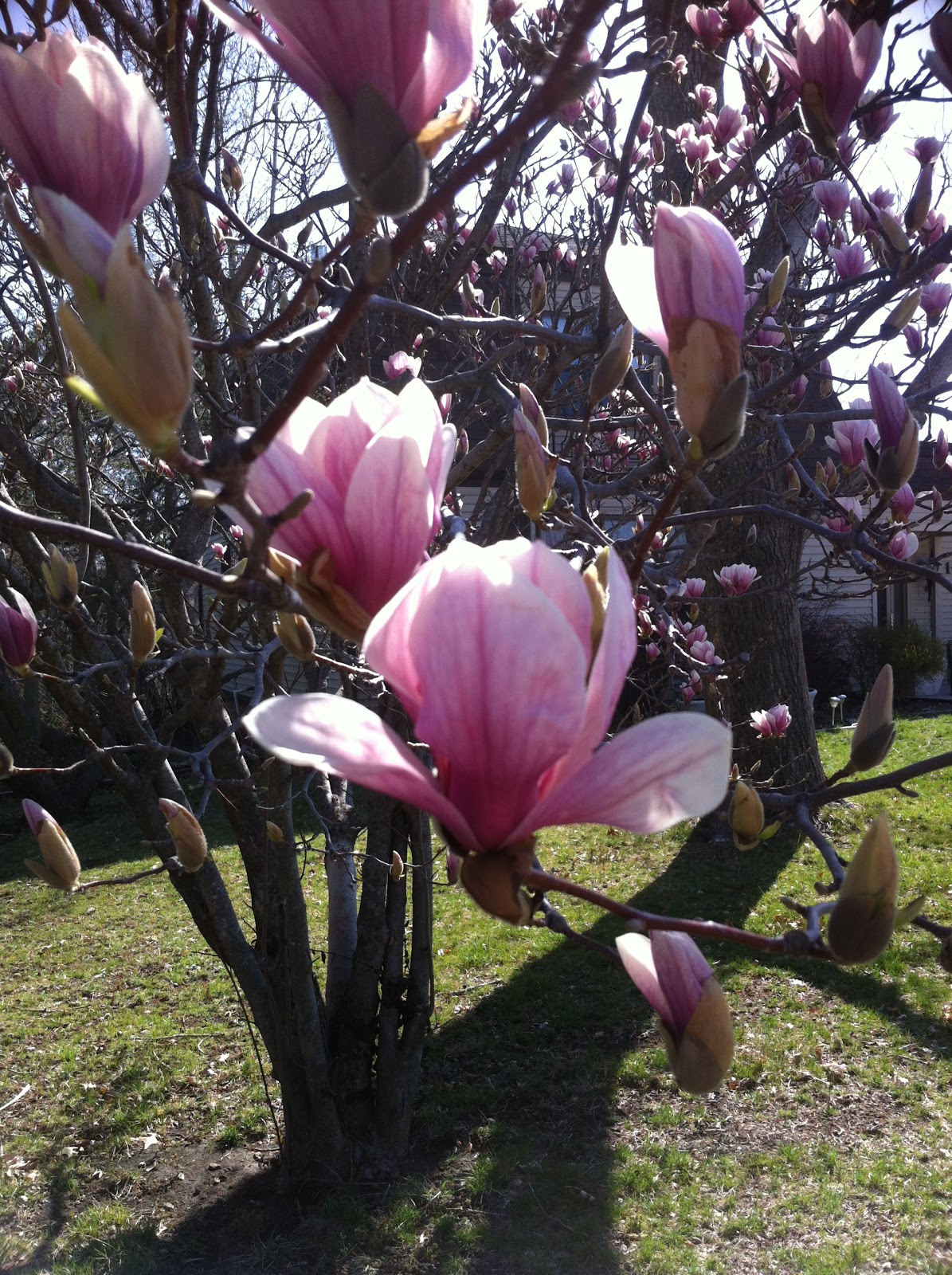
The second group of two pics are the Royal Star Magnolia shrubs. They really can get the size of a small tree. They produce an entirely cold-hardy early spring white floppy flower. They are old fashioned, wild-seeming magnolia. Can't help but love this beauty!


Plum shrub
Star Magnolia Shrub


Early spring, late winter perennial flower. The foliage is almost evergreen, very waxy. Latin name is Hellebore.
Lenten Rose


And of course, the flowering quince! She is coral-red and an old fashioned favorite. She makes a good low ramblinghedge. She has a thorny look and even appeals to me in an Asian garden setting. 


Wednesday, March 7, 2012

Weed walk...spring time in Kansas!

the girls picking henbit
To fully enjoy this crazy spring weather, I'm taking you on a weed walk this week. We will look close to the ground for blooming Stellaria or chickweed and blooming Henbit. This weed turns the fields and roadsides purple in early, early spring.... delicate little heads. Henbit (it has a proper Latin name... I'm looking: Lamium amplexicaule) is in the mint family, as you can tell by its square stem. Also, the smell and taste.


Another pervasive early spring ground cover is Gill or ground ivy.


 I also found, while on a quick walk, that we are too early for nettles. I found dandelion, curly dock being aggressive and all mint family relatives rockin it out. The tiny, tiny chickweed is in bloom- look very close to the ground. She doesn't even flinch when stepped on, she's so small! She is bright blue with a white eye... if you find some of the bigger foliage with the flower, pop it in your mouth. Apparently, chickweed is great for metabolizing fat. Susun Weed has a great chapter about it in her book "Healing Wise" (as always, a link to her publishing company and the bookshelves there!).


And also, on Sunday, we paid a visit to Grandpa Hals' grave... put some henbit on it!