Hal's Hat

Hal's Hat

Friday, March 30, 2012

Miss Spring is throwing things at me!


In the past couple weeks, I have had a lot of "new" stuff coming at me. Is it just because it's spring? Is it that the pace of spring is so FAST this year? It feels like nearly May out there, not the end of March. I have herbs (herbal medicines, native healing weeds) growing from seed and just going nuts! I feel like I'm two-three weeks behind- rushing to plant them, find beds and perfect sites for them . But I'm not late- the mam Earth, Miss Spring herself is training this year. Probably because of some nasty planetary things- global warming, weather shifts- but regardless, the non-winter is gone. And Miss Spring is in the house, playing and prancing. Get on it, she yells with pom-poms waving!
Whitebuds

This week I'm on Jeremy Taylor's 'About the House' radio show. We are doing a spring 'Outside' episode, devoted to the outdoors. It's got me thinking: what are the important parts of a garden? What should our outdoor environments offer us?
This is in the format of advice and also self-reflection. So....Here are the high points for me (so far)


Gardens should offer:


Individuality- even with my clients who are not gardeners, they want something that is their own, reflects their personal touch. Quirky, silly, cute, beautiful, dark, etc. I encourage you to think in terms of love and attraction: what attracts you? what do you love? Many people answer hydrangeas, containers, fountains, travelling. In each of those is a chance to make your garden uniquely your own. When you travel, pick up a figurine for a garden sculpture. For me, I always pick up intense rocks. I have them scattered around my garden and they came with me when I moved. I have the Lola Rock- from Petit Jean national forest, gotten me by my beau Josh!
If you love a specific plant or color for that matter, consult a good gardener or designer (like MOI) for help in siting and growing that specimen. Then commit to that plant. You are much more likely to care for a plant when you love it. Don't get three or five. Just get one and love it, learn about it and pay attention to it. You'll be glad you did!

Surprises- Great garden spaces offer surprises. Remember curves and mystery, great views and surprising plants. This can be a gorgeous container with a large agave in it, sitting amidst a rock garden. Ya don't have to be much of a gardener to keep that up- you do have to dare to surprise though. Stop fussing with all the individual plants and just give me one great, framed view. Please consult a garden professional or your neighbor who is a master gardener- these are the makings of a great neighborhood! Garden professionals LOVE to talk like this!! Really. We are nuts.


Comfort- This could also be called Respite. Your little space should be a respite from the crazy world of work, kids, technology, etc. One element of respite and comfort is a nice place to sit and enjoy your outside space. If colors are what put you in the mood, plant flowers directly next to your bench or patio. And take time, find a great seat. This is your throne- spend a fortune if you want or sit on a footstool. Just make it a personal invitation to YOURSELF. Enjoy your time outside. Don't worry and pick at the imperfections of your space, just take a breath, enjoy the neighbor's lilacs and feel that warm spring air on your face.

Thursday, March 15, 2012

visual aides...


Here is what I've seen and experienced this week in the green world.... very visual this week!

Hal's specialty: good luck clover
A four-leaf clover- happy St. Pat's!


Some of my favorite spring shrubs are in bloom. First the plum shrub. Sometimes I use a Cistena Plum- a purple leaf sandcherry. However, this is the alley version! I don't think it's as fancy as purple leaves!

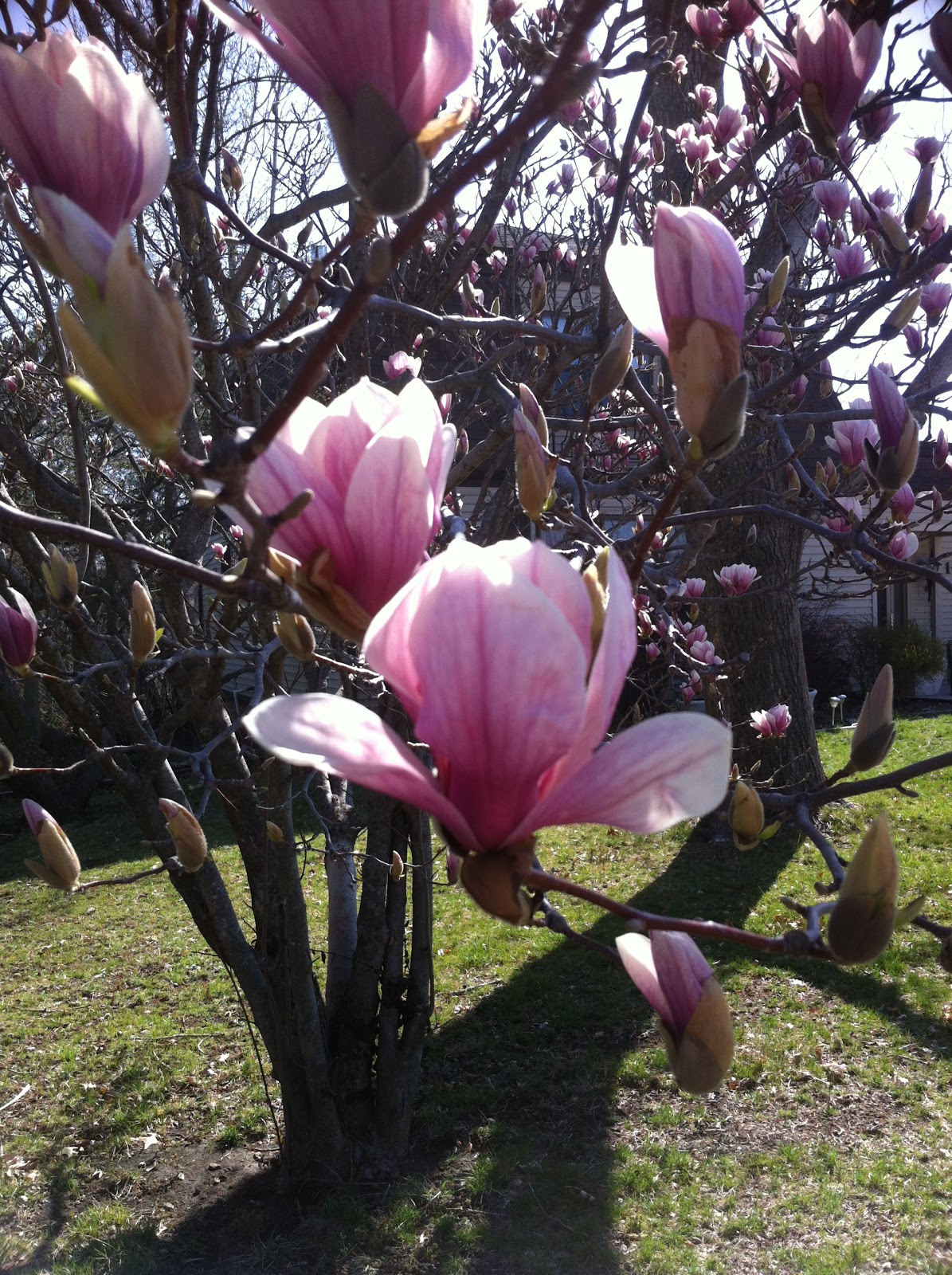
The second group of two pics are the Royal Star Magnolia shrubs. They really can get the size of a small tree. They produce an entirely cold-hardy early spring white floppy flower. They are old fashioned, wild-seeming magnolia. Can't help but love this beauty!


Plum shrub
Star Magnolia Shrub


Early spring, late winter perennial flower. The foliage is almost evergreen, very waxy. Latin name is Hellebore.
Lenten Rose


And of course, the flowering quince! She is coral-red and an old fashioned favorite. She makes a good low ramblinghedge. She has a thorny look and even appeals to me in an Asian garden setting. 


Wednesday, March 7, 2012

Weed walk...spring time in Kansas!

the girls picking henbit
To fully enjoy this crazy spring weather, I'm taking you on a weed walk this week. We will look close to the ground for blooming Stellaria or chickweed and blooming Henbit. This weed turns the fields and roadsides purple in early, early spring.... delicate little heads. Henbit (it has a proper Latin name... I'm looking: Lamium amplexicaule) is in the mint family, as you can tell by its square stem. Also, the smell and taste.


Another pervasive early spring ground cover is Gill or ground ivy.


 I also found, while on a quick walk, that we are too early for nettles. I found dandelion, curly dock being aggressive and all mint family relatives rockin it out. The tiny, tiny chickweed is in bloom- look very close to the ground. She doesn't even flinch when stepped on, she's so small! She is bright blue with a white eye... if you find some of the bigger foliage with the flower, pop it in your mouth. Apparently, chickweed is great for metabolizing fat. Susun Weed has a great chapter about it in her book "Healing Wise" (as always, a link to her publishing company and the bookshelves there!).


And also, on Sunday, we paid a visit to Grandpa Hals' grave... put some henbit on it!

Wednesday, February 22, 2012

Herbal medicine cabinet?

This week's blog is going to be a bit of a ramble.... Ready?
I'm planning out my herbal market garden. I've found a lovely north Lawrence plot on which to grow a larger selection and quantity of herbs. And they will be for sale! I'm going to make my tinctures, herbal vinegars, cut herbs (both culinary and medicinal), teas/ infusions and infusion blends, salves/ infused oils available for sale.
  • I'll be growing more burdock, echinacea and yarrow for tincture. For the herbal vinegars, I'll grow nasturtium, dill, motherwort, lemon balm. 
  • I'm growing basil, dill, rosemary, lavender, lovage, cilantro/ parsley for culinary use (maybe thyme, sage too).
  • I'm growing st. john's wort- but it won't be available for use until next year. 
  • I'm growing calendula, rosemary and comfrey for infused oils as well. 
  • For herbal infusions, I'll cultivate some nettles, red clover and mint assortments... the rest TBD. 
  • Sage and garlic will be grown for honey syrup.
  • I'm also trying to locate some reliable elderberry- so that I can syrup it!! Leads? Who has leads on this?
So my question to those of you who read this blog: How important are these herbs to you? Are they part of the weekly/ monthly budget?
I'm really excited to bring this out finally. As most of you know, I grow lots of vegetables (usually), and lots of herbs for my own consumption. But to actually commit to growing herbs for other people... it's new for me! I have been giving away my bottle of tinctures and infusions for awhile. This is a new challenge that I feel totally up for.


Here are two herbs I'm studying and feeling called towards: Osha root and Elecampane. 


Osha 
Parts used- Root
Recommended preparation: tincture or honey tincture (could do glycerin/ glycerite)


Many older herbalists or people who take herbs and make herbals know about this root. It is, right now, over harvested and under grown. It is hard to grow cultivate and only grows wild in the mountains. Osha root is also know as Bear root or by our native First Nations folks, Bear medicine. Bear apparently, in folk tales, love it like a cat loves catnip! They roll in it, rub it on their fur and before hibernation eat loads of it. I've read a story that purported that a male bear would offer this during "courtship"/ mating rituals to females. Whoa nelly- do you get that this is a powerful plant? I surely do. 
Long nosed herbalists, the crones and oldie-goldies among us caution us to NOT buy Osha. Or to buy a tiny bottle and use a tiny amount. It is a superb ally for the chest and coughs, the lungs and lung issues. It is also amazing, I've read, at acting as an anti-venom for stings and bites (the tincture). I have a bottle of Osha root in honey for my smalls. It is for rooting out the cough and includes mullein in there too. It is great to loosen the mucus and allow the cough to be more  fruitful.


Water hemlock/ poison hemlock
A wordy aside (and a word to the wise): Osha is grown only at high elevations (where bears would live, folks). But it is a relative of the carrot (Queen Anne's Lace is a wild carrot) and also the cooking herb lovage. It is also very close to poison hemlock or water hemlock. It's leaves, to my eye, are very very similar! Now, you may or may not be aware of this poisonous herbaceous weed. But it is everywhere, in parks, in alleys, by your car. It looks like parsley (feathery leaves) or wild carrot or common carrot. But it is taller and has a thick stalk that is tinged with purple. I absolutely loathe and stay away from this as if it was poison ivy. It can give a rash and transfer its poison when a curious person crushes the leaves to do a smell test. It smells rank, musky, weird. Osha smells fresh, herbaceous, spicy, deep. Here is a picture of water hemlock:

Elecampane
Parts used- Root
Preparation: make a honey of this root. Root can also be candied and eaten. Great substitute for Osha root. 
Now, I'm loving the elfish herb. She has a mini sunflower look (is a Helenium, related to sunflowers and ragweed), loves WET soil and has powerful herbal medicines for relieving congestion and bronchitis. Perfect for this season, no?
Elecampane can be cultivated on your well drained but moist garden soils, with partial shade accepted. How great is that?? Add her to your cottage garden in the shady areas. 
Elecampane

Tuesday, February 7, 2012

Apple Cider Vinegar, Burdock and tinctures

Good morning to you all,
I've taken a long time to get to this next post. Why? It's complicated.
I'm working on this right now: anxiety. How to deal with this holistically? What can I do to minimize my anxiety and transferring to those around me? I will accept any advice on this whole anxiety matter. I'm trying very hard to veer away from pharmaceuticals. While I really believe that there are SO many people who are helped by these, I believe that my emotional state is situational (child induced) and changing. Therefore, a whole biological upheaval of SSRI is not my idea of a good time. Also, my kids are making me bonkers. Martini time anyone?

Apple Cider Vinegar
Well beyond that, you all have asked that I talk about Apple Cider Vinegar! I need to talk about Burdock and nourishing strategies for your winter body. Maybe you are dry, tired and overwrought? Oh, that's just me.
Firstly, let me say that I don't "take" cider vinegar. I don't want to down a spoonful with water. Just don't want to. Many of you do... good work. However, I use cider vinegar for herbal infusions or herbal tinctures. Many herbs that work well in vinegar include edible, culinary herbs. Do you see where I'm going with this? Vinegar is another substance that can act as a tincture medium. It sucks the juices and good stuff out of your magic plant and saves it for a nice bowl of beans! I use vinegars anytime I make beans, meat soups, veggies stir-fry, salads, etc. Apple cider vinegar is famous for releasing calcium in everything.... you heard that right. It makes calcium available. That is miraculous since calcium is a tricky thing to absorb from most foods. Though I love green food, I do not love cooked greens (mustard, chard, kale). I need it mixed and not as it's own dish. It's just... not for me. And it is the primo source for absorb-able calcium!! So I do vinegars instead.
I use culinary herbs- thyme, rosemary, dill with edible flowers for zing! I use calendula flowers and nasturtium most frequently.
Motherwort, wot.
I use motherwort in vinegar. Leonurus cardiaca...Ever use it? It is a superb mood ally for the stressed out mothers among us. It does not harm men to take it- it has no hormonal effect but is calming. I LOVE IT. It is a "weed" that grows in alleys. It has a toothed leaf and appeared in my alley in KCKS. [Miss you, 'Dotte! But not really.] It's another in the large, in charge mint family. Laminaceae. Seems to be annual- but self sows seriously and will just keep setting itself out. But the whole plant seems to do a Borage and bloom itself unto death.


I use echinacea vinegar. I don't want to belabor the benefits of echinacea but it is a tried-and-true immune booster. Not for daily use, but for instances where you feel compromised and about to get sick, it will help you out. Take a break after 7 days or so. Listen to it- put echinacea tincture on your countertop. When you feel it calling you, take it. If you're getting sick and you know it, a dropperful every hour for a day. See if it helps.
Other herbal vinegars I enjoy: Melissa officinalis (Lemon Balm)- yummy and lifts the spirit! Pepper vinegar- lots of good capsicum for the internals. Dandelion- oh my yes. I eat the greens in the spring when tender, always making sure to pick from a totally unsprayed section of land. I dig and use the root and leaves in fall for vinegar. It is a stomach tonic- keeping your hydrochloric acid in good shape (this is digestive juice folks). [Note: If you're taking antacids, please stop! This kills your digestive juices.] So dandelion helps fix ulcers and other stomach owies. And is an incredible source of minerals- vitamin A, C, potassium, iron and more. Research it if you have a delicate stomach!

Burdock
Please note that I found burdock leaf vinegar inedible. Too bitter for me! I really have a relationship with burdock root and am taking the tincture daily right now. I love it- it is a deep, dark healer or ally for the liver and kidneys. But I use the root only. The leaf is just... WOOF. I use it in floral arrangements. :)
So Burdock: It has huge, huge hairy coarse leaves and an enormously long taproot. It loves to grow near rocky ledges, walls and disturbed areas. It loves old foundations and will be very hard to dig out. I have a whole trip on getting burdock root out of the ground--- want to hear it?

To dig Burdock:
** I wait for the first few freezes in the fall.
** I go out on a nice sunny, frosty morning with my narrow shovel and choose big second year plants. (I think other burdock aficionados have a different take on this... I could be doin' it wrong!) Burdock has a two year life span. Second year plants are meatier and larger and produce more bang for your sweating, digging buck.
** I dig in a circle around the base, not too wide but three inches out from it.  Then I keep going deeper around, pushing soil up with my shovel. If you are too quick, you will just break the root and have nothing to show for it. If you are patient and listen to your plant charge, you will see what is happening. It will come loose. Points that you will not like: most Burdock grows in rocky places. It's gonna be a bit precarious. You'll need to dig up a few plants to get the right amount- I'm talking 5-8 plants. I want to gather a whole quart jar full of this root. It will be very muddy (don't dig when it's too dry- impossible). I soak them in a bucket outside- I've learned that mucking up the sink sucks. Scrub these roots- they hold dirt particles. I then cut up the roots into pieces and cover the whole jar in vodka. I tincture in a special way- it is the Hal Sears method!

Taking burdock:
To get the medicinal support from burdock root, choose your medium. Vinegar, if you don't want alcohol: tincture, if you don't mind the alcohol flavor or the root itself as a food. The Chinese use this in soups and stews (see Gobo root). I use tincture and I take it three times a day for 6 weeks. The I take a break. I usually switch to a root vinegar to continue to get the healing effects. Burdock works slowly and methodically. It will not bowl you over with quick changes. But my skin shows a noticeable improvement whenever I choose to holistically support my liver. I choose not to take a handful of pills to help my liver- the liver sees through this!! It knows you're wanting a fast fix and will probably give you the stink eye. Your liver is one of the most important organs in your body and, along with your kidneys, will let you know when it is exhausted from your bad lifestyle choices (or from whatever else, medication, children, career= stress). Yep I said bad. Judging!


To tincture:
How Hal tinctured: he didn't use grain alcohol and ratios to figure it out. He just used vodka- local cheap stuff from Weston, MO in plastic jug (McCormick, locavore). This produces a tincture that is strong but not too strong. Make sure your jar is packed full with plant material. He and I cover all the plant material with vodka, no open space at the top of the jar. Seal it with a jar lid (you may use wax paper to prevent corrosion; vinegar is the worst!) and let it sit for 6 weeks in a dark place. Shake it as often as you think of it. Label it with the date you harvested and made the tincture. Decant it when it is done; rinse and squeeze the plant material to get all the *stuff* out of it. Add the pummy back into the vodka tincture. Label accordingly.


Friday, January 20, 2012

Butterfly garden...


One of the things I do in the garden world is to talk to Jeremy, the Brit, on his show About the House. (It's AM radio folks. Listen live if you don't know how to do AM on your radio. ha.) Every couple of weeks, I'll talk about some seasonally appropriate gardening topics. This week I've decided to bring up an entirely over-used, but awesome, topic- the butterfly garden. Part of why everyone wants to talk about / plant them/ enjoy them is because they do so well here in the Midwest. It features annuals that can be grown from seed and re-seed themselves, perennials that (if not native exactly) will become very comfortable in your KS garden and a few shrubs for structure and year-round interest.
We have lots of sun and soil that is not overly fertile (it's usually perfectly fertile, just lots of clay). Butterfly plants love this setup.
Add wind protection for the butterflies. Never use chemicals or pesticides (a granular time-release fertilizer when you amend your soil is ok). Add a place for the b'flies to get water- either a hollowed rock that holds water or a place to put moist soil will do. 

-Low Maintenance (no fancy pruning required)
-Xeric or simple water requirements (would like regular water until established, please!)

A Simple Plant List


Shrubs to ground the bed:
Buddleia, ‘Black Knight’ (wonderful dark purple butterfly bush- 5-6’H) (from plant)
Not "Black Knight" buts still nice.
Rhus typhina (Sumac), ‘Tigers Eye’ (from plant)
  
Perennial Flowers from plant: I mark these as "from transplant" because they will bloom reliably the first year from a plant. A seed start may take two years
Achillea (Yarrow), ‘Paprika’ (plant)  
Coreopsis gradniflora, ‘Zegreb’, ‘Early Sunrise’ (plant)
Echinacea purpurea, ‘Magnus’ (seed or plant)
Lavendula, ‘Hidcote’ (plant)


Asclepias
Asclepias tuberosa (Butterfly weed) (plant) food source
Monarda (Bee Balm), ‘Raspberry Wine’ (plant)
Sedum, ‘Vera Jameson’ (shorter and less likely to topple over) (plant)


From Seed:
Bronze Fennel (direct sow) - food source
Echinacea purpurea, ‘Magnus’ (direct sow or plant)
Larkspur (direct sow) - nectar
Liatris (Gayfeather) (plant, from seed) – nectar
Sunflower, Mexican Sunflower (direct sow)

There are lots of other wildflowers (annuals, perennials) that you could plant if you want things that direct sow and reseed: bachelor buttons, cleome, cosmos, poppies, nicotiana, zinnia


Wednesday, January 11, 2012

Seed Catalogs...

(this is a repost of my blog for Lawrence Landscape)
 
Seed Catalogs- January 5, 2012
It is seed catalog time folks! If you are like me, you will begin to be inundated with tons of catalogs, seducing you with pictures and tips and ideas for this next season’s garden. Be careful! Needless to say, my eyes are bigger than my “plate”. To save you money and frustration, let me give you some rules to follow.

            
  • How many seeds do you have left over from last year? If they have gotten too warm, wet or are really older than a year, they are probably not viable. Feel free to do a germination test!
  • Be honest about how many plants you can fit in your space! How many square feet do you really have in full sun where the soil drains well? BE HONEST.
    • All vegetables and many annual cutting flowers require the same full sun site. I include them with my seed buying (zinnias, marigolds, nasturtiums, bachelor buttons, cosmos, etc.).
    • All of that space has to be water accessible. It’s nice that you have a broad sunny strip of easement. But can your hose or drip system reach out there?? Vegetables require deep, regular soaking for highest yield.
    • Also, follow the spacing/ mature sizing listed for each plant you will put in. I mean, do not crowd your broccoli or your squash- it will wreck your yield and/ or promote fungal growth!  If the seed packet says it needs to be planted 36” apart, plan on that spacing. Base your spacing on the mature size of your plant. I often shove in some smaller annuals or herbs around larger vegetables to beautify my plot. But I do not crowd out my major producers.  (Example: I love summer squash and zucchini but it is a huge space hog. Do I have the space for it?)
  • What do you eat most of and is really expensive locally?? Tomatoes? Basil? Eggplant? Zucchini? For me, I must have and eat an enormous amount of greens (lettuce, spinach, chard), beets, tomatoes, basil (I pesto it up), zucchini. However, what of my favorites is very affordable locally? Squash and zucchini, regular bell peppers and green beans. Potatoes, onions are inexpensive for me locally.  I also love to grow all my own herbs because they are too, too much to buy- I use a bunch of herbs! THIS IS YOUR MASTER LIST.
Not all of this will you want to start from seed.
  • What grows best directly seeded (or needs repeat sowing)? Lettuce, greens, beans and peas, roots like carrots and beets, dill, basil, cilantro. For me: beans, lettuce, greens, beets, herbs.  Also, many old fashioned cutting flower varieties are only available from seed. If you are having a cutting garden, make sure you consult your MASTER PLAN! Do you have room?
  • What do I need LEAST of (that do great from transplant)? Examples include: cherry tomatoes, Thai hot peppers (amazing but who needs 18 plants of this??) or any exceptional “one off”, eggplant (for me personally). I also don’t need 18 thyme plants. I buy these from my favorite farmer’s market booths! 
Laurel’s Master list- based on four 4’ x 10’ raised beds (and a little cheating with some pots)
Tomatoes- paste tomatoes (8) (S), slicing tomatoes (4) (N)
Basil- one long row (8-16 plants) (S)
Beans- pole beans (Blue Lake or some other long bean) 1 long rows (DS)
Beets- 1 long row (DS)
Chard- 1 row (DS)
Lettuce- 2 rows Buttercrunch, 2 rows leaf (interplanted with Bean and Peppers) (DS)
Spinach-2 rows (DS)
Cilantro- interplanted with other hot season veg. (N)
Peppers- bell (4), jalapeno (4) (N)
Arugula- 2 rows (DS)
Zucchini- 1 long row on a trellis (DS)
(DS)- direct sow, (S)- from seed, plant start, (N)- buy start from nursery
What did I forget??? Herbs.
Thyme (S)
Basil (S) already mentioned: Purple Ruffles, Boxwood Basil and Genovese
Rosemary (N)
Lemon Balm (S)
Yarrow (S)
Italian Parsley and Cilantro (N)